
Executive Technology Catalogue
HECO GGH V1
Hydrogen Generator
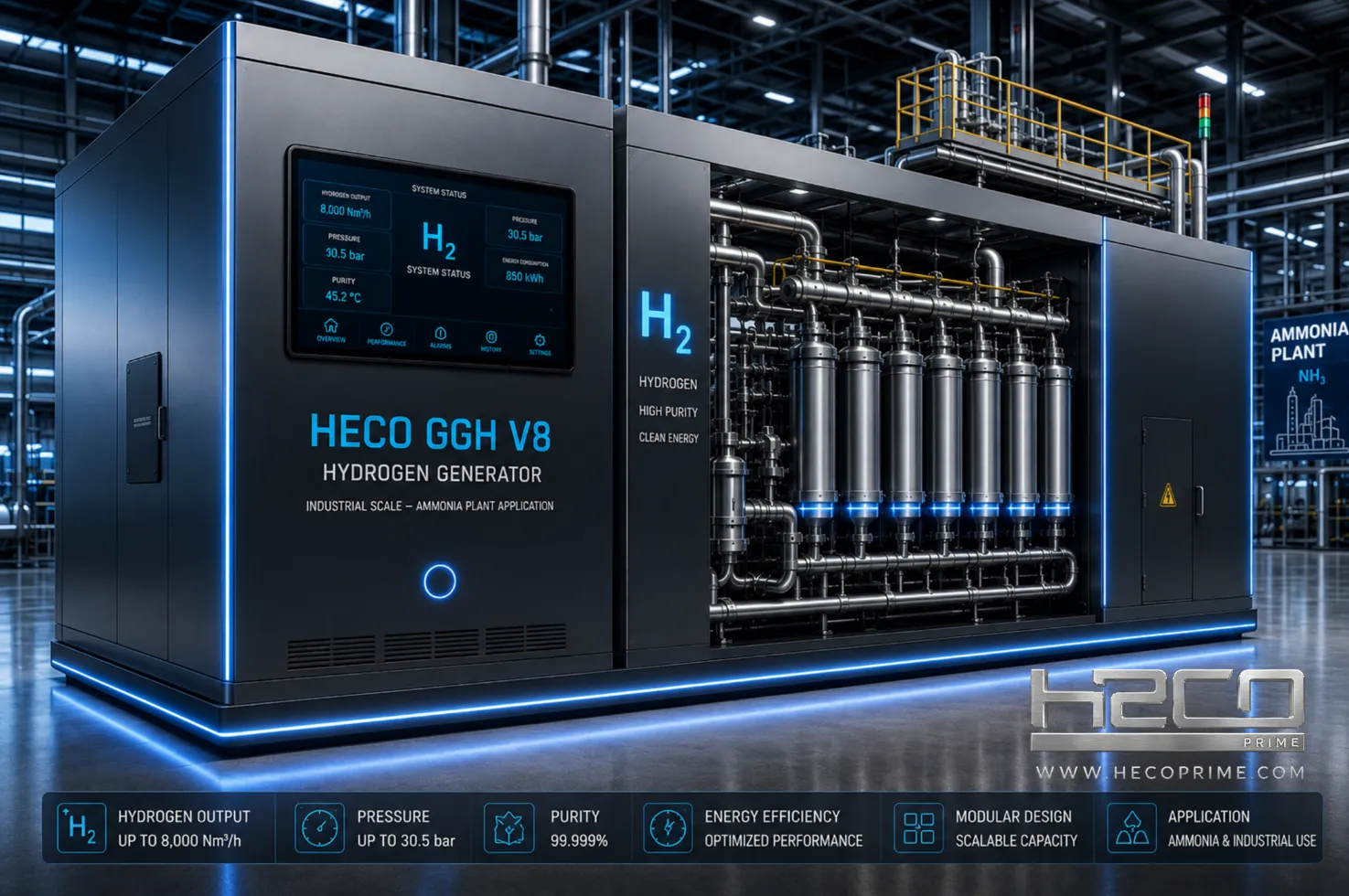
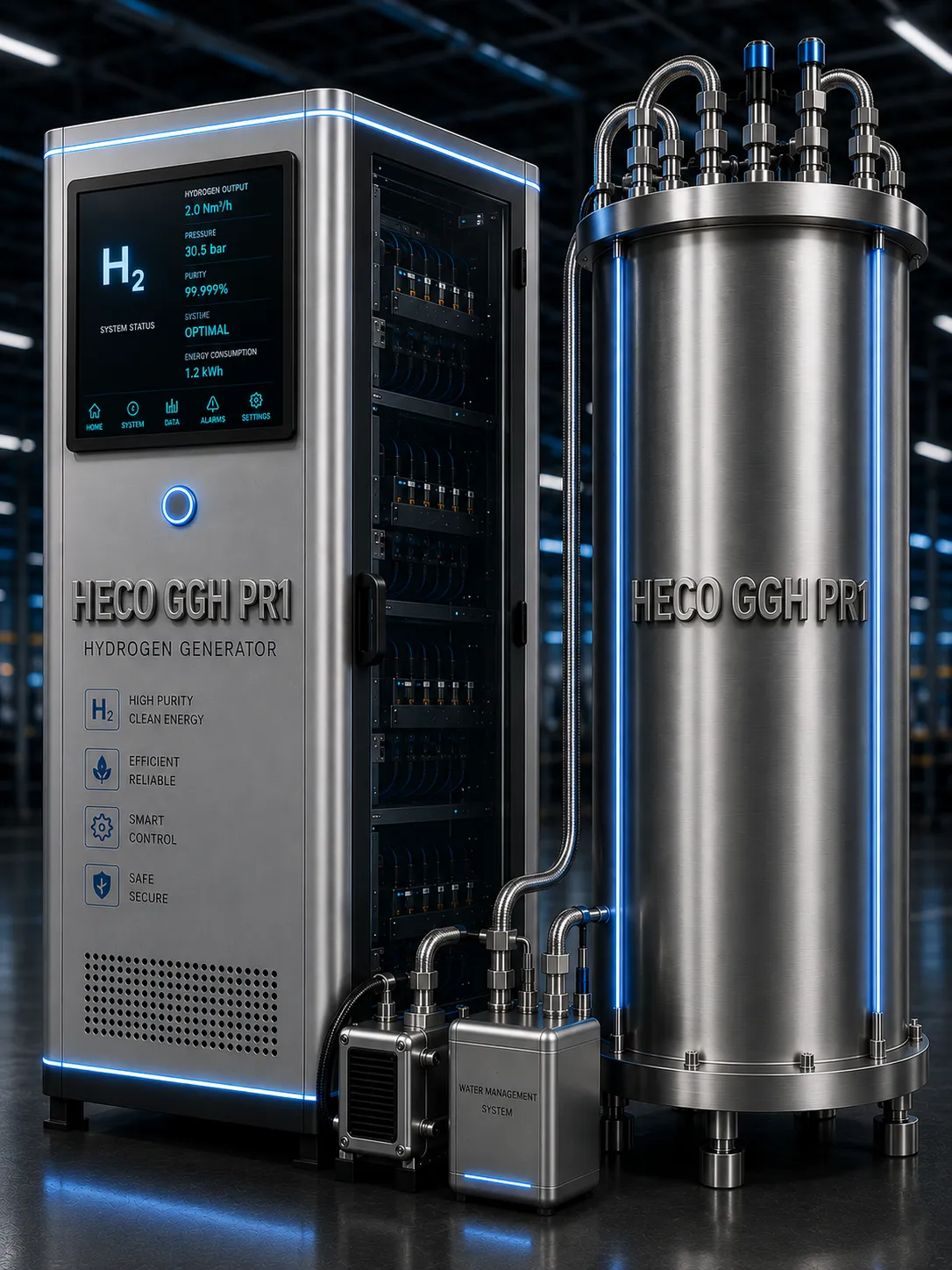
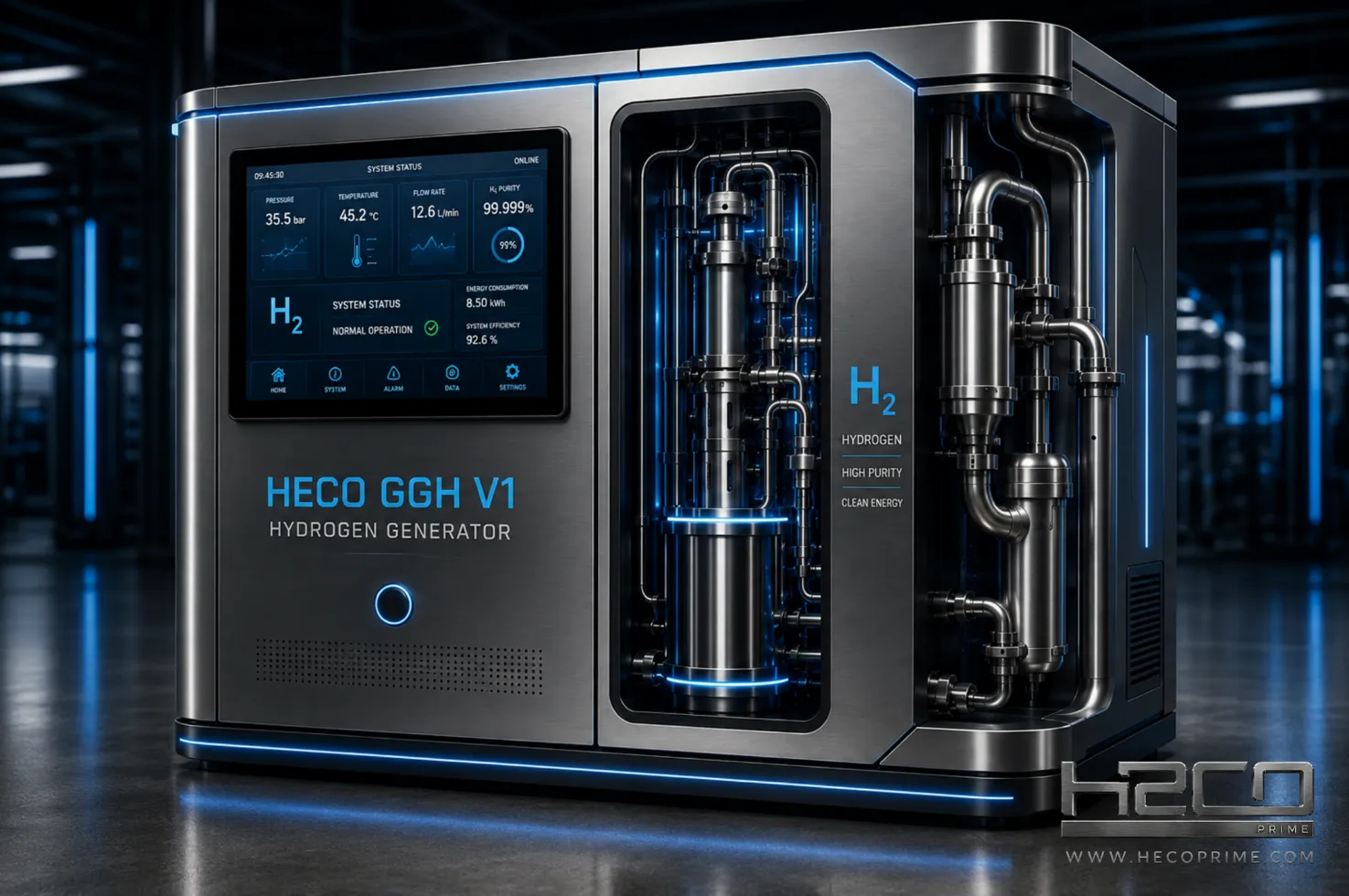
Images for illustrative and reference purposes only. Prototype and test configuration forming the technical basis of the HECO GGH V1.
On This Page
Catalogue Index
Section 1
HECO Prime
HECO PRIME is an innovation-driven technology company focused on hydrogen generation, clean-energy integration and scalable industrial systems. The company combines international industrial experience, proprietary technology, prototype development, technical testing and a modular product strategy.
The HECO GGH platform is designed as a family of generators that can evolve from compact demonstration units to distributed and industrial systems. The common engineering philosophy is controlled water processing, electrochemical generation, intelligent power management, gas monitoring and modular balance-of-plant integration.
| Strategic element | HECO PRIME position |
|---|---|
| Core field | Hydrogen and clean-energy systems |
| Business model | Equipment, licensing, integration and technical support |
| Product philosophy | On-site, modular and application-specific generation |
Section 2
Corporate Trajectory
| Period | Milestone |
|---|---|
| 2000 | International business intermediation and supplier development |
| 2004 | Creation of World Prime Services for industrial and mining markets |
| 2008 | Expansion into industrial consulting and engineering |
| 2017–2020 | International expansion, multinational supply and new industrial sectors |
| 2022 | Strategic transition toward clean energy and hydrogen |
| 2023–2024 | Prototype preparation and IPT technical testing |
| 2025 onward | HECO GGH product-family development and industrialisation |
The hydrogen programme represents the convergence of the group’s trajectory: international market access, industrial engineering experience, technology protection and the development of a scalable product platform.
Section 3
Patents and Intellectual Property
HECO PRIME’s hydrogen programme is supported by an international intellectual-property strategy. Company records report patent applications and protection activity in several jurisdictions, including approvals or granted rights in Taiwan and Bolivia, together with additional international filings.
The protected scope is presented as proprietary process concepts, equipment arrangements, operating logic and integration methods associated with hydrogen generation. Patent numbers, filing dates, claim scope and current legal status must be confirmed against official certificates before the final legal edition of the catalogue.
| Protection layer | Purpose |
|---|---|
| Core generation process | Protect proprietary method and operating sequence |
| Equipment architecture | Protect relevant mechanical and electrochemical arrangements |
| Control and integration | Protect system relationships and operating logic |
| International coverage | Protect target commercial and manufacturing markets |
| Confidential know-how | Preserve materials, parameters and assembly methods |
Section 4
Future of Hydrogen and Market Costs
Global hydrogen demand is approximately 100 million tonnes per year and remains concentrated in refining, chemicals and industrial processes. Low-emissions hydrogen still represents only a small share, creating a major opportunity for technologies that can reduce cost, simplify deployment and produce hydrogen close to the point of use.
Future demand is expected in ammonia, methanol, green steel, refining, heavy transport, maritime fuels, long-duration storage and selected power applications. Projects with low-cost electricity, reliable demand and reduced transport requirements are expected to have the strongest economics.
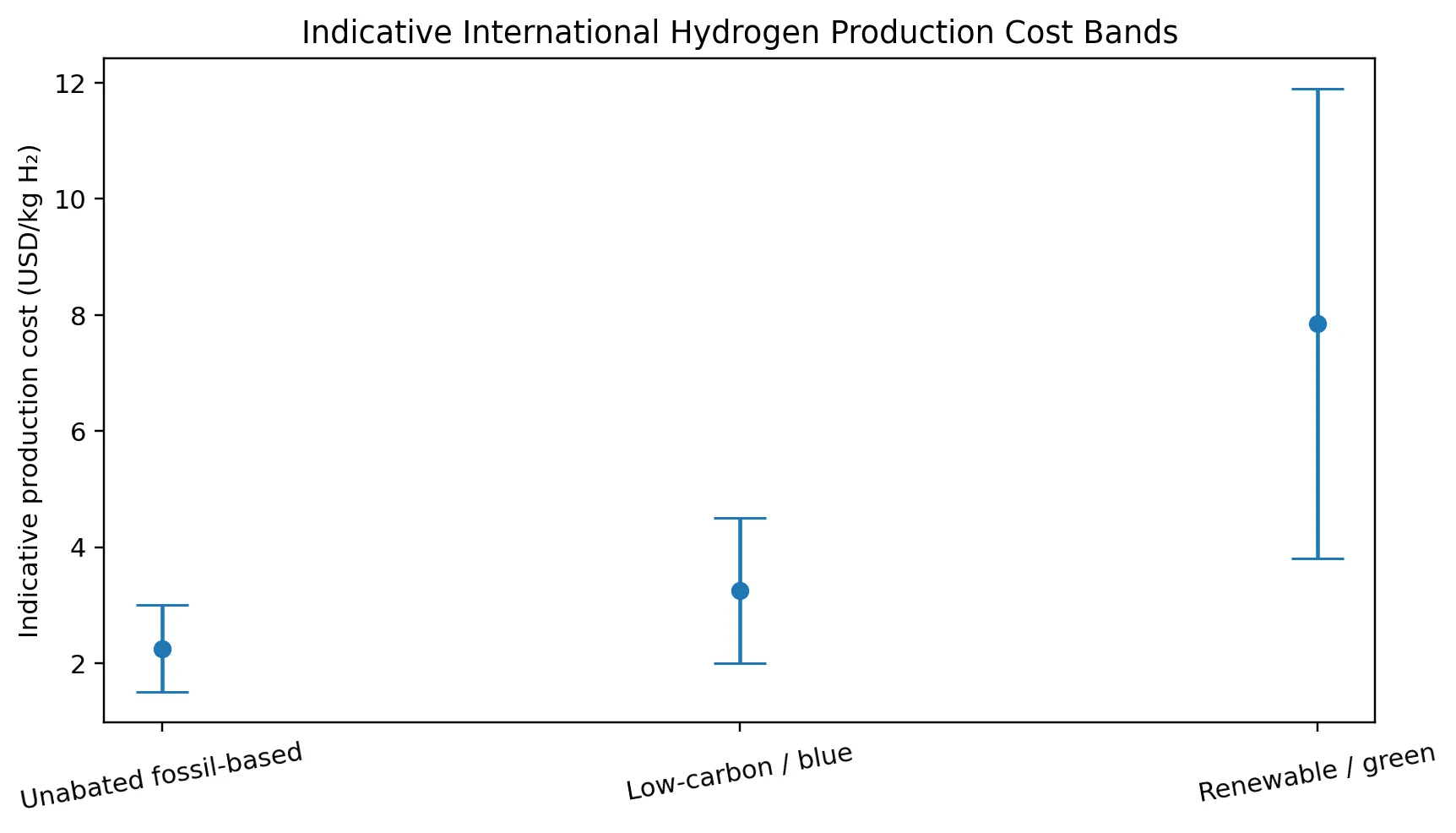
| Production route | Indicative cost environment |
|---|---|
| Fossil-based hydrogen | Generally lowest current cost, but exposed to fuel and carbon prices |
| Low-carbon / blue hydrogen | Intermediate cost with dependence on gas and carbon capture |
| Renewable / green hydrogen | Higher current cost in many markets, with long-term reduction potential |
Section 5
HECO Generation Principle
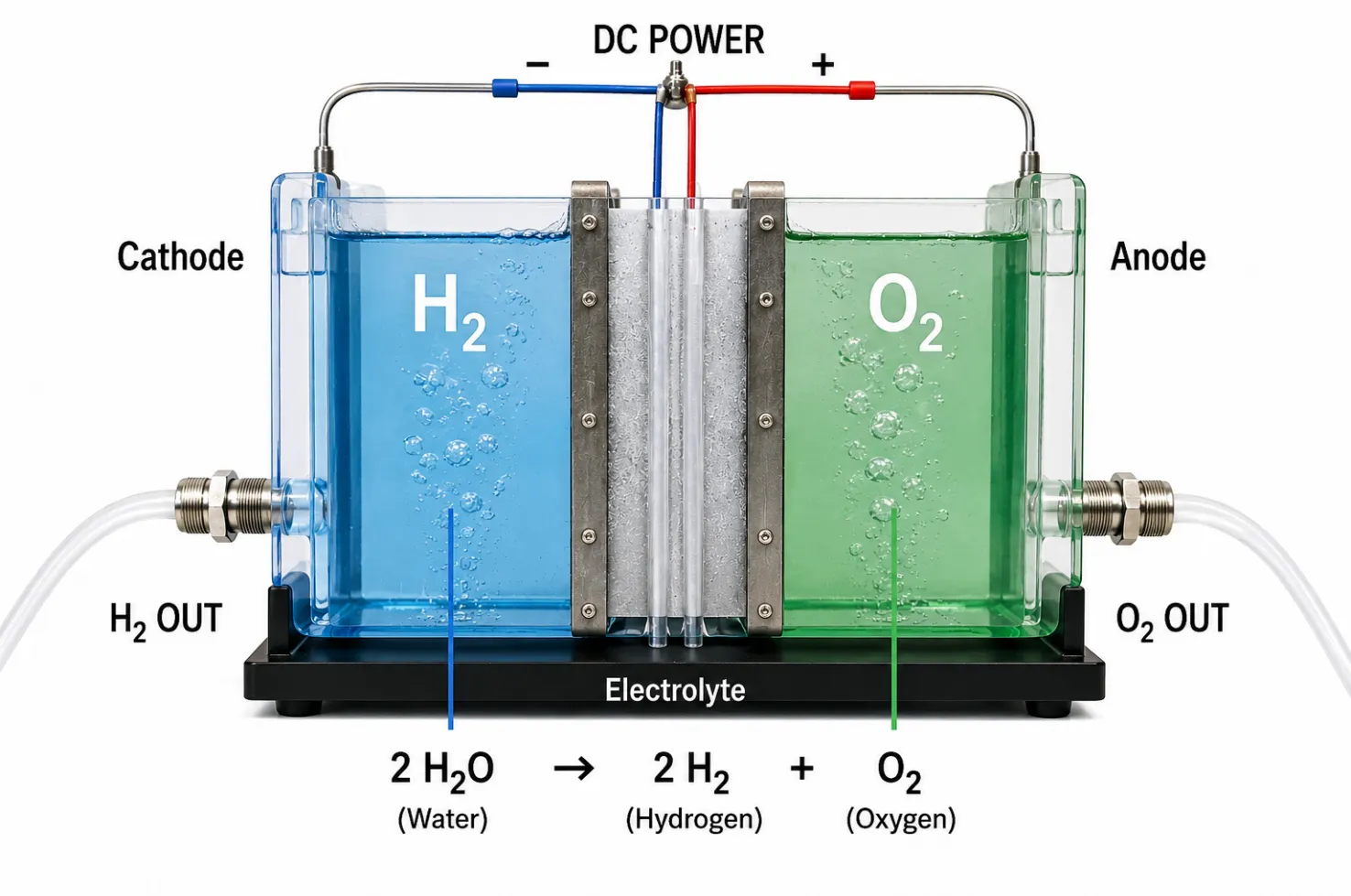
The HECO GGH platform generates a hydrogen-rich gas stream through a controlled electrochemical process in which electrical energy is applied to water. Inside the generation cell, the anode and cathode are separated by an electrolyte or ion-conducting medium, allowing the water-splitting reactions to occur in a controlled environment.
5.1 Electrochemical Water-Splitting Process
When direct current is supplied to the cell, oxidation occurs at the anode and reduction occurs at the cathode. Hydrogen is formed on the cathode side, while oxygen is formed on the anode side. The overall idealised reaction is:
2 H₂O → 2 H₂ + O₂
The Department of Energy describes electrolysis as the use of electricity to split water into hydrogen and oxygen. Electrolyser systems may range from compact distributed equipment to large central production facilities. HECO PRIME applies this same established scientific principle within its proprietary module arrangement, power-control strategy, water-management logic and integrated equipment architecture.
| Element | Function | HECO Engineering Focus |
|---|---|---|
| DC power supply | Provides controlled electrical input | Stable voltage, current regulation and operating efficiency |
| Anode | Supports the oxidation reaction and oxygen formation | Material selection, durability and reaction stability |
| Cathode | Supports the reduction reaction and hydrogen formation | Surface performance, gas release and long service life |
| Electrolyte / ion path | Carries ions between the electrodes | Conductivity, compatibility and controlled operating conditions |
| Water-management circuit | Maintains process-water availability and condition | Level, temperature, quality and circulation control |
| Gas outlets | Direct hydrogen-rich and oxygen-bearing streams | Safe routing, monitoring and downstream treatment |
5.2 Proprietary HECO System Integration
The differentiating value of the HECO GGH platform is not limited to the basic chemical reaction. It is concentrated in the way the cell modules, electrical controls, process-water management, gas routing, instrumentation and safety functions are engineered as one integrated system. The objective is to maintain stable production, reduce avoidable energy losses and support modular expansion for different customer requirements.
| Control Area | Operational Objective |
|---|---|
| Electrical control | Maintain the required operating window and protect the generation modules |
| Water and temperature control | Preserve process stability and avoid performance degradation |
| Gas monitoring | Measure flow, composition and operating conditions |
| Safety and interlocks | Provide alarms, controlled shutdown and protection against abnormal conditions |
The illustration is a conceptual technical diagram. Final HECO GGH V1 construction details, electrode geometry, internal materials, process parameters and control logic remain subject to engineering validation and proprietary intellectual-property protection.
Section 6
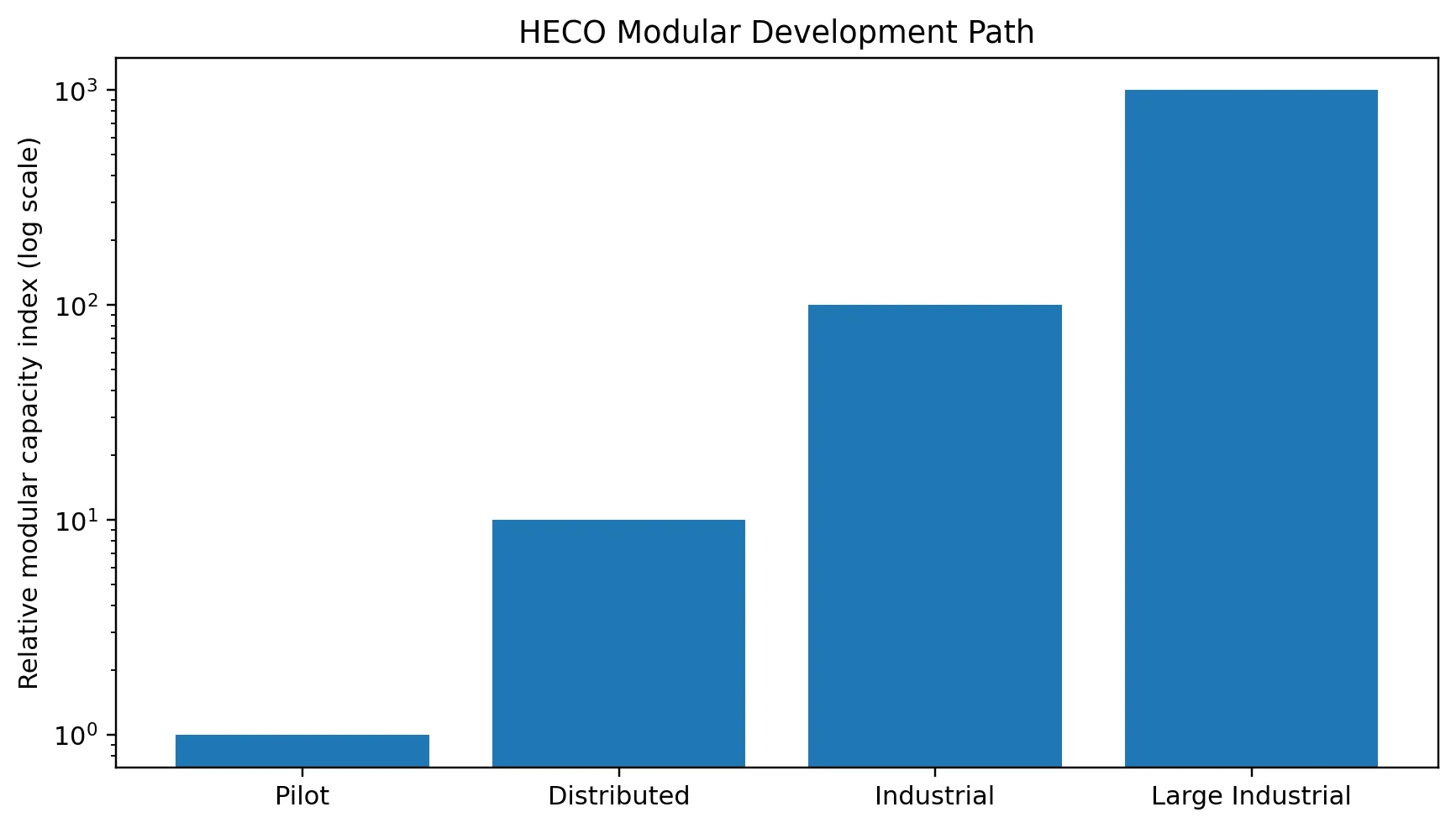
Product Family and Capacity Levels
| Model | Positioning | Need level |
|---|---|---|
| HECO GGH V1 | Compact pilot and distributed unit | Low to moderate demand |
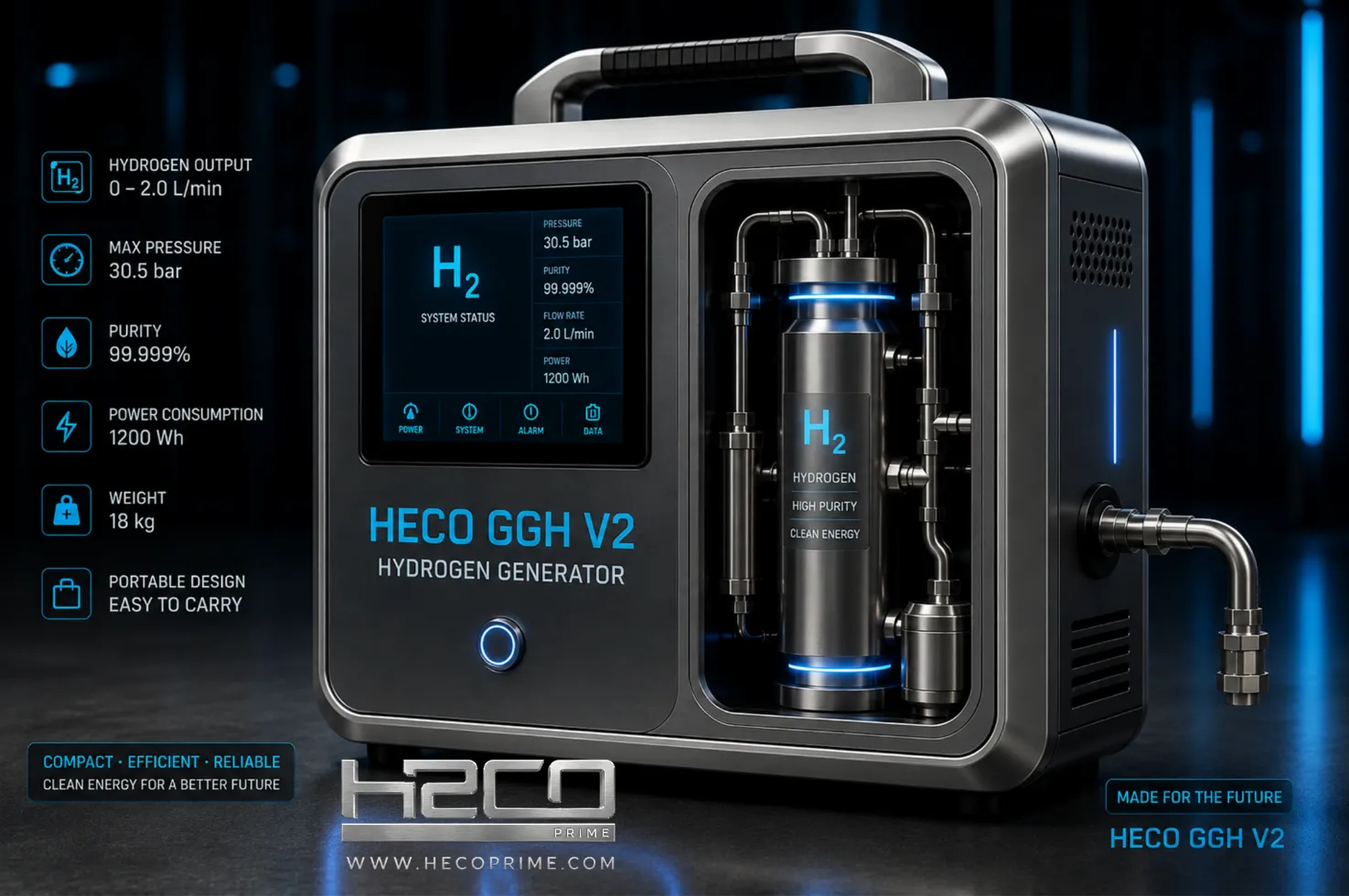
| HECO GGH V2 | Portable or field-oriented unit | Mobile or temporary demand |
| HECO GGH V3 | Industrial high-capacity system | Continuous industrial demand |
| HECO GGH Custom | Project-engineered multi-train system | Large or application-specific demand |
Final capacity is defined in kilograms per day according to required purity, pressure, operating hours, redundancy, available power, water quality, site classification and applicable safety standards.
Section 7
HECO GGH V1
| Development basis | Current reference |
|---|---|
| Electrical supply used in tests | 220 V |
| Process liquid | Mineral water without added electrolyte |
| Small-generator water volume | 3.5 litres |
| Selected recorded power range | Approximately 510–658 W |
| Intended role | Pilot, demonstration and distributed-generation platform |
| Status | Engineering development and industrialisation programme |
The HECO GGH V1 is the first product-development model derived from the tested platform and serves as the reference architecture for controlled generation, customer validation and future modular scale-up.
Section 8
IPT Small-Generator Tests
The system was tested at the Instituto de Pesquisas Tecnológicas (IPT), through the Laboratory of Bioenergy and Energy Efficiency. This catalogue presents only the small generator, which produced the most representative results for the HECO GGH V1 development programme.
| Equipment | Measurement |
|---|---|
| Minipa ET-4055A | Electrical power and energy |
| LAO G6 | Volumetric gas flow |
| Sick S710 | Hydrogen and oxygen concentration |
| Test interval | Measurements at five-minute intervals |
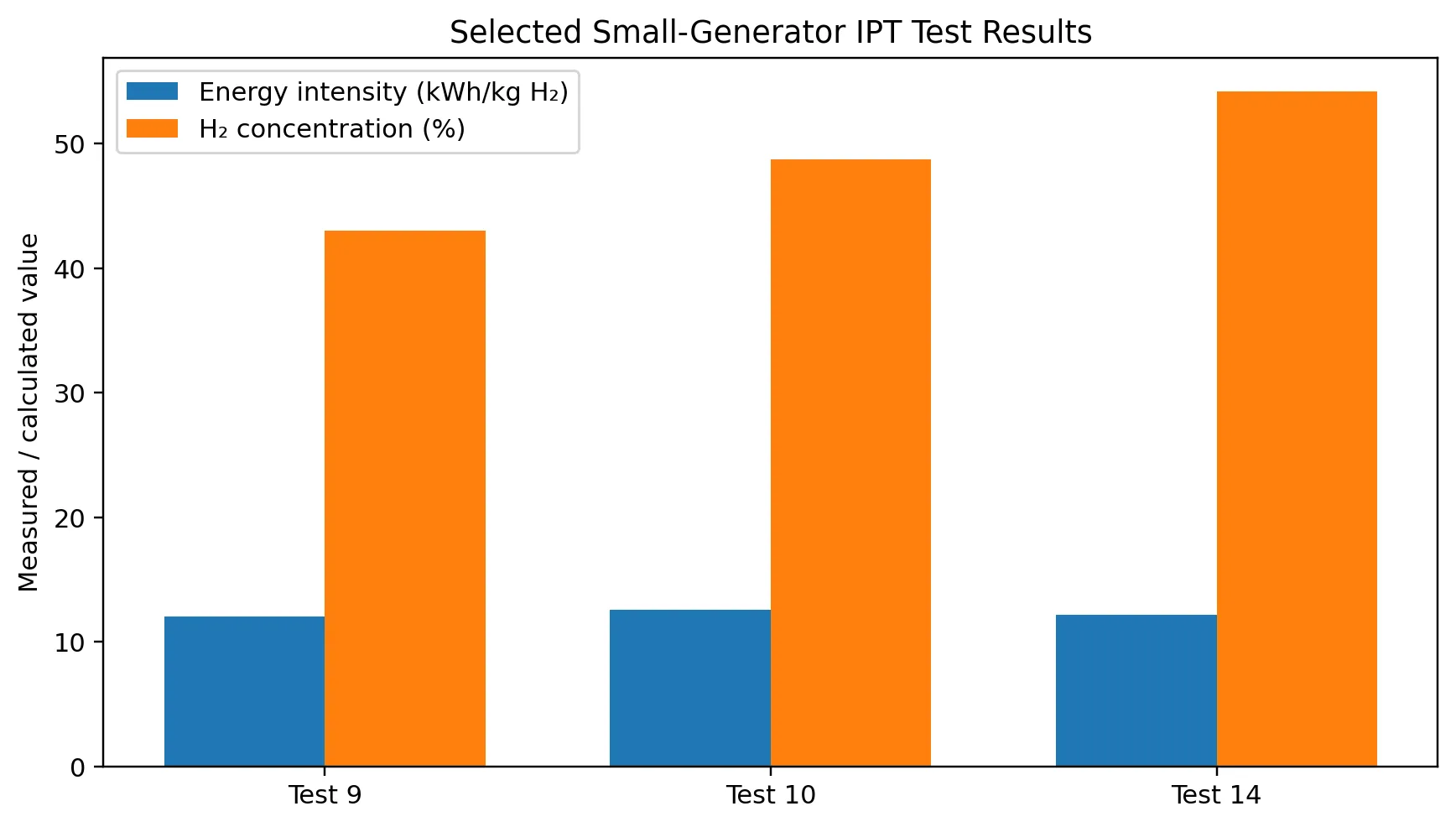
The selected records show combinations of relevant hydrogen concentration, gas flow and comparatively low calculated energy intensity. These are test-point calculations and are not yet a continuous industrial guarantee.
Section 9
Performance and Cost per Kilogram
| Test | H₂ | Flow | Power | Calculated intensity |
|---|---|---|---|---|
| 9 | 43.02% | 1.932 m³/h | 1.597 kW | 12.02 kWh/kg H₂ |
| 10 | 48.72% | 1.416 m³/h | 1.401 kW | 12.60 kWh/kg H₂ |
| 14 | 54.20% | 0.888 m³/h | 0.964 kW | 12.19 kWh/kg H₂ |
The highest recorded small-generator hydrogen concentration was 58.18%. The selected results support an internal development target below 14 kWh/kg H₂ under defined conditions, subject to confirmation in continuous testing.
Section 10
Indicative Cost and Industrialisation Roadmap
| Electricity price | Electricity-only cost at 12.19 kWh/kg |
|---|---|
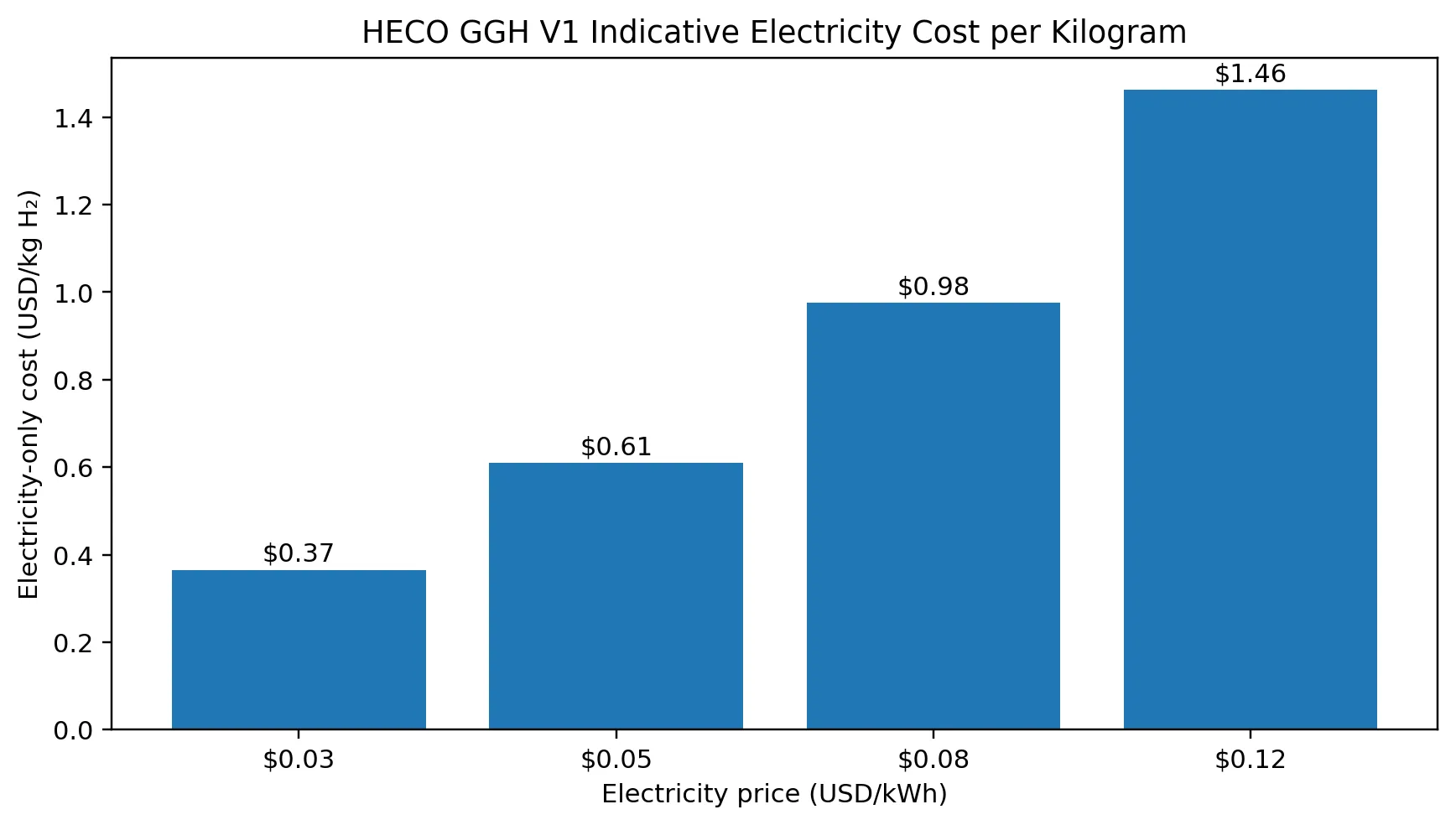
| USD 0.03/kWh | USD 0.37/kg H₂ |
| USD 0.05/kWh | USD 0.61/kg H₂ |
| USD 0.08/kWh | USD 0.98/kg H₂ |
| USD 0.12/kWh | USD 1.46/kg H₂ |
These values exclude CAPEX, financing, water treatment, maintenance, cooling, purification, compression, storage, labour, certification and distribution.
| Roadmap phase | Purpose |
|---|---|
| V1 engineering | Consolidate design, instrumentation and safety |
| Continuous validation | Confirm repeatability and long-duration performance |
| Certification | Prepare the product for regulated commercial markets |
| V2/V3 scale-up | Integrate parallel modules and industrial utilities |
| Project systems | Add purification, compression, storage and customer integration |
Section 11
Industrial and Commercial Applications
The HECO GGH product family is designed for applications where hydrogen is required near the point of use, where logistics and storage materially affect cost, or where customers need a modular path from pilot testing to continuous industrial production.
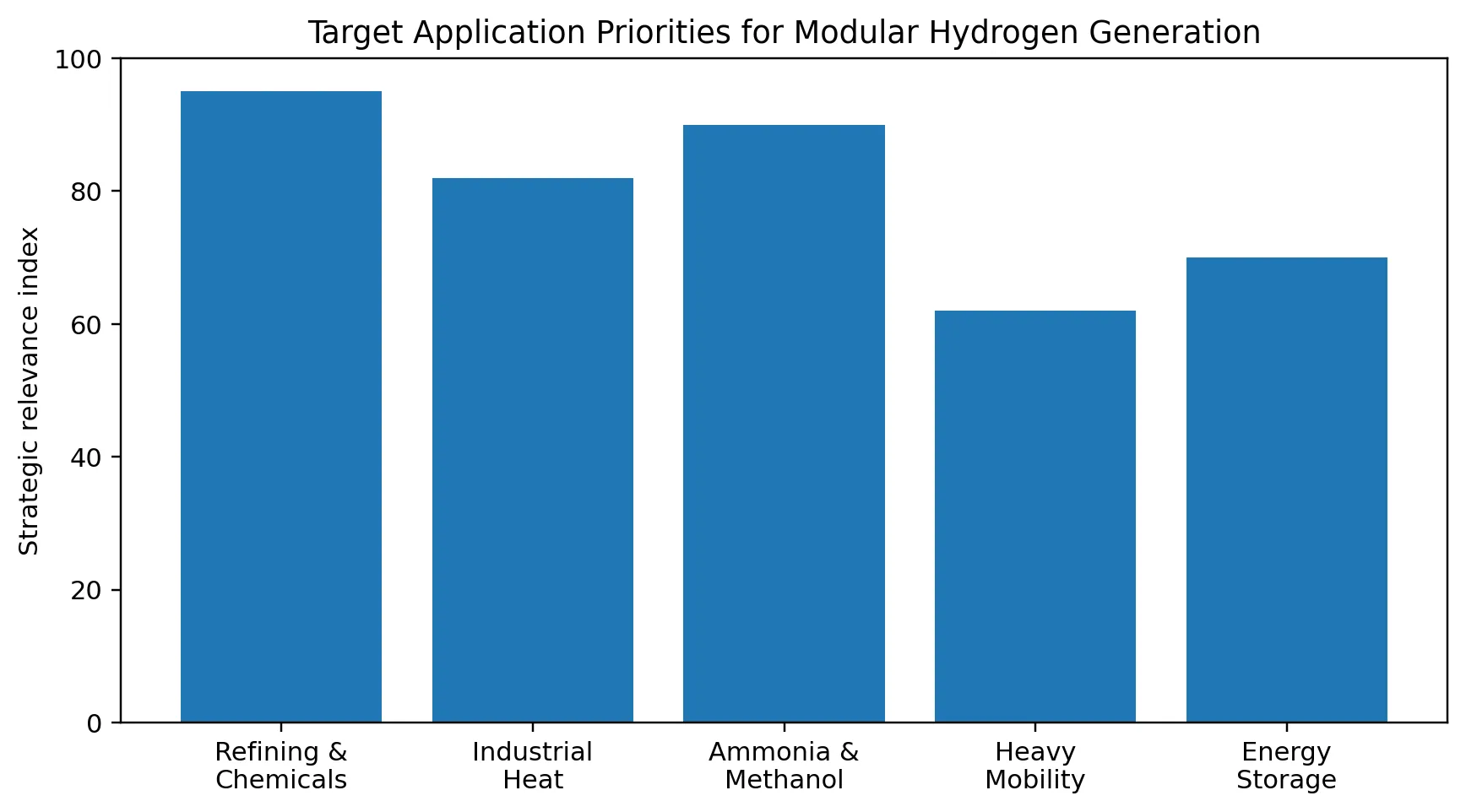
| Application | Hydrogen function | HECO concept |
|---|---|---|
| Refining and chemicals | Feedstock and treatment gas | Continuous modular generation |
| Ammonia and methanol | Primary molecular feedstock | Industrial multi-module system |
| Mining and metallurgy | Thermal, reduction and mobile uses | Rugged skid configuration |
| Heavy mobility | Fuel for fleets and equipment | Purification and compression options |
| Power and storage | Long-duration energy storage | Renewable-coupled production |
Section 12
System Sizing and Customer Requirements
Generator selection is based on the customer’s complete operating requirement, not only nominal gas flow. HECO PRIME defines each project by demand, gas quality, pressure, operating profile, utilities, site conditions and redundancy.
| Design input | Required information |
|---|---|
| Hydrogen demand | kg/day, kg/hour, peaks and annual consumption |
| Gas specification | Purity, moisture, oxygen limit and contaminants |
| Delivery condition | Outlet pressure, temperature and supply profile |
| Operation | Hours/day, days/year and load variation |
| Utilities | Electrical capacity, water, cooling and ventilation |
| Site | Climate, altitude and hazardous-area classification |
| Redundancy | Single train, N+1 or complete backup |
12.1 Configuration Levels
| Need | Model | Configuration |
|---|---|---|
| Pilot / demonstration | HECO GGH V1 | Single monitored module |
| Portable / temporary | HECO GGH V2 | Compact reinforced package |
| Continuous industrial | HECO GGH V3 | Parallel modules and shared utilities |
| Large custom demand | HECO GGH Custom | Multiple trains, treatment and storage |
Section 13
Installation and System Integration
The commercial HECO GGH unit is intended as an integrated package or engineered skid. Installation engineering must treat generation modules, electricity, water, gas routing, ventilation, controls and the customer interface as one system.
| Integration area | Engineering requirement |
|---|---|
| Electrical | Protection, grounding, isolation and emergency shutdown |
| Water | Defined quality, supply, drainage and service access |
| Ventilation | Prevention of hydrogen accumulation |
| Gas handling | Compatible piping, non-return protection and controlled venting |
| Instrumentation | Flow, pressure, temperature, power and composition |
| Customer interface | Defined connections, battery limits and control signals |
| Maintenance | Safe inspection and component replacement access |
Final installation must comply with local electrical, fire, pressure, environmental and occupational-safety requirements.
Section 14
Safety, Control and Compliance
Hydrogen is light, highly diffusive and flammable over a wide concentration range. Safe design depends on preventing accumulation, controlling ignition sources, monitoring abnormal conditions and moving the equipment to a predictable safe state.
| Safety function | Design objective |
|---|---|
| Hydrogen detection | Identify leakage or abnormal accumulation |
| Ventilation | Maintain dilution in enclosed areas |
| Pressure protection | Limit overpressure and provide controlled relief |
| Electrical protection | Isolate faults and protect power circuits |
| Process interlocks | Prevent operation outside approved limits |
| Emergency shutdown | Stop generation and isolate energy safely |
| Remote monitoring | Provide alarms, records and maintenance data |
Development should be aligned with the applicable edition of ISO 22734 for hydrogen generators using water electrolysis and with relevant electrical, pressure, machinery, functional-safety and hazardous-area requirements.
Certification depends on final design and destination market. No certification claim should be made before conformity assessment is completed.
Section 15
Sustainability and Resource Efficiency
Hydrogen’s environmental performance depends on electricity origin, complete-system efficiency, water management, equipment life and the emissions of the customer’s existing alternative. HECO PRIME’s objective is efficient local generation connected to renewable, grid or hybrid electricity.
| Sustainability factor | Project consideration |
|---|---|
| Electricity source | Renewable supply provides the strongest low-emissions potential |
| Energy efficiency | Lower kWh/kg reduces operating cost and indirect emissions |
| Local production | Can reduce transport and cylinder-handling exposure |
| Water management | Controlled quality, monitoring and responsible discharge |
| Modular expansion | Capacity follows real demand |
| Durability | Long service life reduces replacement intensity |
15.1 Responsible Performance Claims
Hydrogen generation does not automatically qualify as green or low-emissions. Classification depends on electricity origin, project boundaries, certification methodology and regulation.
Measured generator consumption should be reported separately from purification, compression, storage and delivery energy so that commercial comparisons use equivalent system boundaries.
Section 16
Commercial Deployment and Project Execution
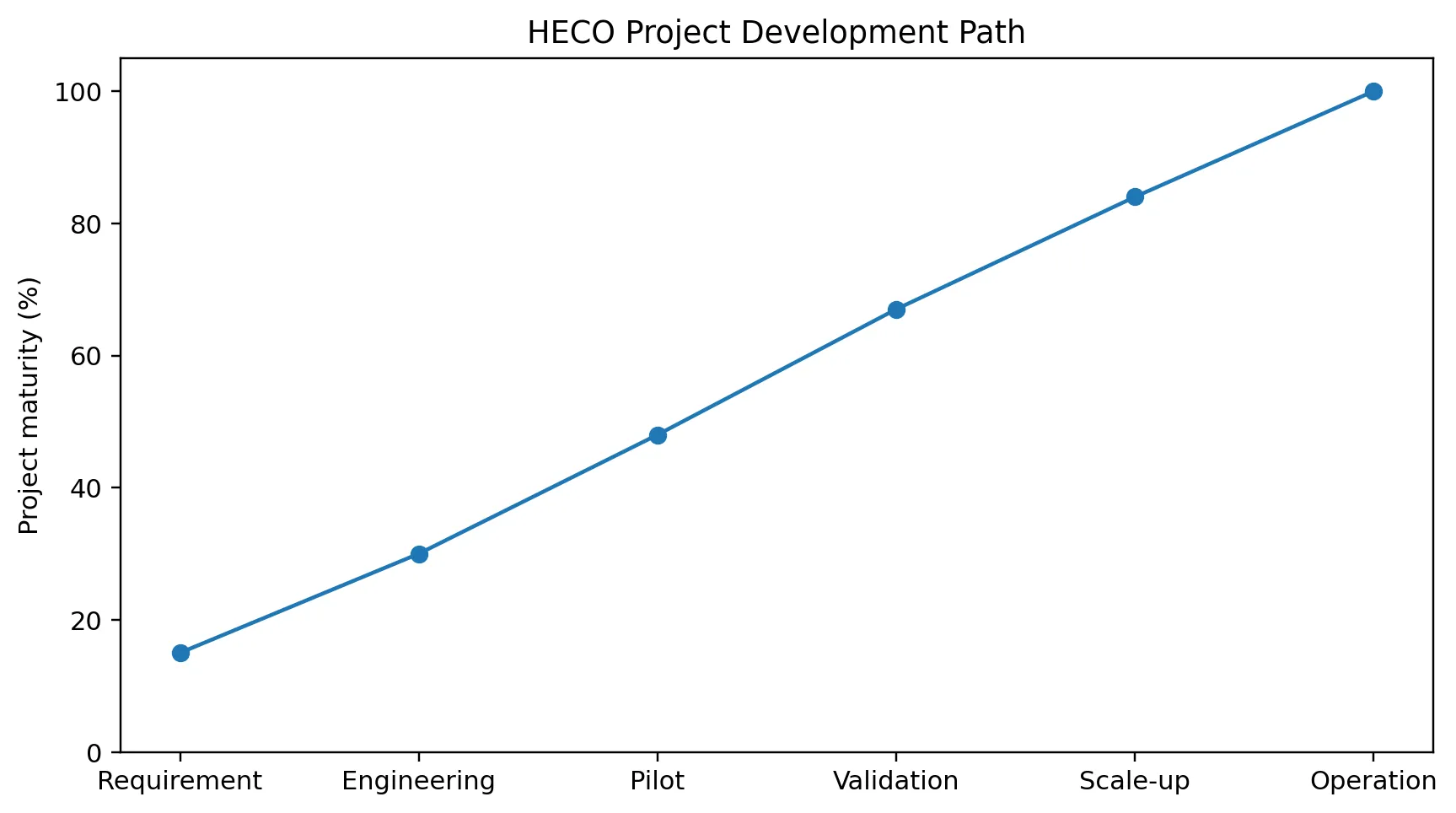
| Project phase | Main deliverable |
|---|---|
| Requirement definition | Demand, site data and hydrogen specification |
| Concept engineering | Model selection and preliminary economics |
| Pilot configuration | HECO GGH V1 demonstration or application test |
| Performance validation | Continuous operation, quality and energy verification |
| Industrial scale-up | V2, V3 or custom multi-module system |
| Operation and service | Monitoring, training, maintenance and support |
Commercial proposals should distinguish the core generator from optional purification, drying, compression, storage, dispensing and customer-process integration.
Section 17
Technology Development Commitment
HECO PRIME is developing the HECO GGH family as a progressive technology platform. The immediate priority is to consolidate the V1 design, complete extended-duration validation and establish repeatable performance under controlled conditions.
| Commitment | HECO PRIME objective |
|---|---|
| Technical validation | Stable, repeatable and auditable performance |
| Intellectual property | Protection of technology and manufacturing know-how |
| Industrial engineering | Conversion of prototypes into commercial products |
| Modularity | Equipment for different customer demand levels |
| Safety and compliance | Alignment with applicable international requirements |
| Customer integration | Solutions matched to the point of use |
The next stage is the creation of portable, distributed and industrial models using parallel generation modules, improved controls, industrial materials, remote monitoring and application-specific gas conditioning.
Section 18
HECO Prime Competitive Advantages
The HECO GGH platform is being developed as a modular hydrogen-generation architecture focused on point-of-use production, progressive scale-up and application-specific integration. Its value is created by combining electrochemical generation, power management, water control and monitoring within one product family.
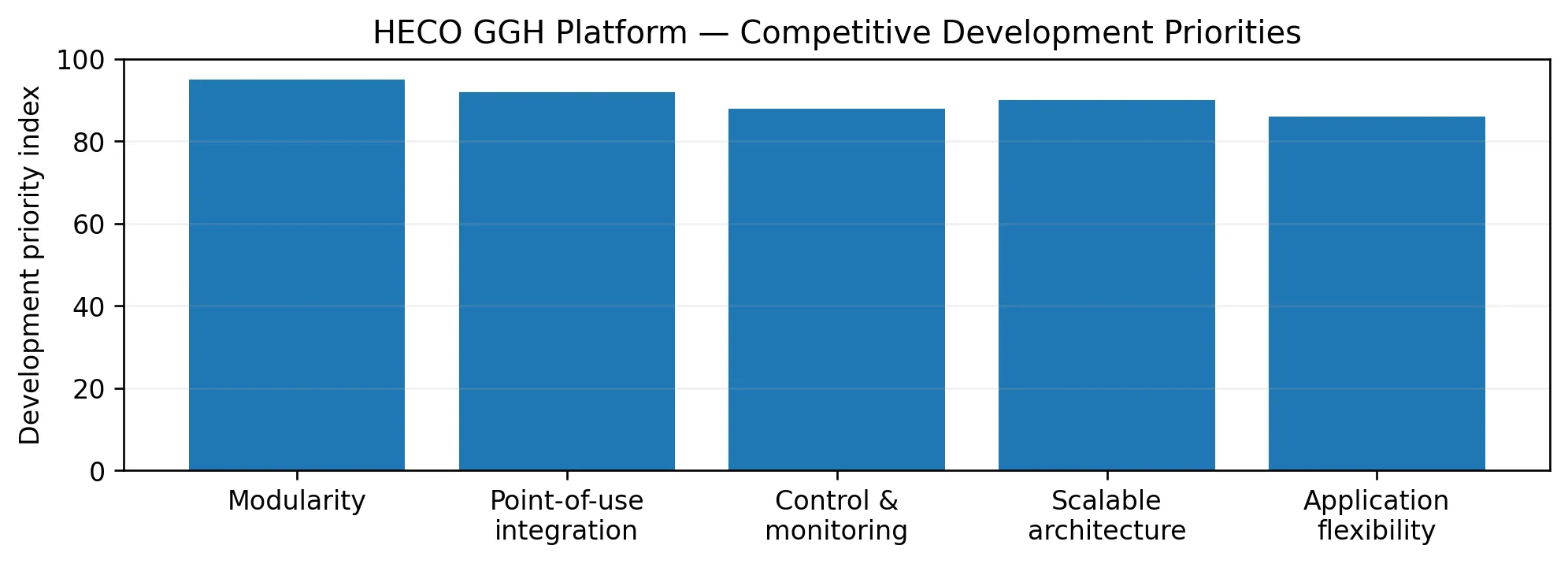
| Competitive dimension | HECO GGH value proposition | Customer relevance |
|---|---|---|
| Modular architecture | Common platform designed for pilot, portable, distributed and industrial configurations. | Capacity can be expanded in defined stages as demand is validated. |
| Point-of-use generation | Hydrogen is produced close to the customer process rather than supplied only through external logistics. | Potential reduction of cylinder handling, transport exposure and supply interruptions. |
| Integrated control concept | Electrical, water-management, gas-monitoring and shutdown functions are engineered as one system. | Improved operational visibility and a clearer path to automation. |
| Application flexibility | Configuration can be adapted to flow, gas quality, pressure, duty cycle and site conditions. | Supports industrial, research, energy and customised applications. |
Executive Positioning
HECO PRIME positions the HECO GGH family as an evolving product architecture rather than a single fixed machine. Generation modules, controls and downstream treatment are combined according to each project. Commercial claims remain linked to verified test conditions and to the complete system boundary.
Section 19
HECO GGH Product Family
The HECO GGH product family was developed using a modular engineering platform to support hydrogen generation solutions for different industrial applications while maintaining a common architecture, standardized service procedures and scalable deployment.
| Model | Application | Capacity Class | Architecture | Scalability |
|---|---|---|---|---|
| GGH V1 | Pilot / Laboratory | Compact | Integrated | Entry |
| GGH V2 | Commercial | Medium | Modular | Expandable |
| GGH V3 | Industrial | Large | Multi-module | High |
| Custom | Special Projects | Project-defined | Custom | Unlimited |
Engineering Philosophy
Every HECO GGH platform is designed around the same engineering principles: modularity, maintainability, industrial robustness, operational safety, and future expansion without complete equipment replacement.
Section 20
Technology Comparison & Modular Architecture
The HECO GGH platform was conceived as a modular hydrogen generation system allowing progressive expansion without redesigning the complete installation. Standardized interfaces simplify maintenance, commissioning and future upgrades.
| Feature | Conventional Systems | HECO GGH Platform | Benefit |
|---|---|---|---|
| Expansion | Equipment replacement | Modular expansion | Lower investment |
| Maintenance | Model-specific | Standardized modules | Reduced downtime |
| Installation | Dedicated layout | Flexible layout | Simpler deployment |
| Scalability | Limited | High | Future capacity growth |
| Service | Different spare parts | Common architecture | Inventory optimization |
Modular Architecture
Core Generator Module → Process Module → Control Module → Safety Module → Industrial Integration. This architecture enables phased implementation from pilot installations to large industrial projects.
Engineering Advantages
- Modular construction philosophy
- Standardized maintenance procedures
- Expandable capacity
- Industrial-grade mechanical structure
- Scalable automation architecture
- Long-term platform evolution
Section 21
Industrial Applications & Deployment Scenarios
The HECO GGH platform is designed to support hydrogen generation projects across multiple industrial sectors through a scalable and modular deployment strategy. The same engineering philosophy can be applied from demonstration projects to large industrial installations.
Primary Application Sectors
| Sector | Typical Application | Deployment Scale | Key Advantage |
|---|---|---|---|
| Industrial Plants | Process hydrogen | Medium/Large | Continuous operation |
| Energy Projects | Energy integration | Large | Modular expansion |
| Research Centers | Technology validation | Small | Flexible configuration |
| Special Projects | Customized systems | Variable | Engineering adaptation |
| Future Infrastructure | Hydrogen hubs | Large | Long-term scalability |
Deployment Strategy
Phase 1 – Pilot validation
Phase 2 – Commercial deployment
Phase 3 – Industrial expansion
Phase 4 – Multi-site integration
Platform Benefits
- Standardized engineering
- Reduced installation complexity
- Modular capacity growth
- Industrial maintenance philosophy
- Flexible integration with existing facilities
- Future-ready architecture
Section 22
System Integration & Industrial Implementation
The modular architecture of the HECO GGH platform enables integration with industrial utilities, control systems and future hydrogen infrastructure. The standardized engineering approach reduces project complexity and supports phased expansion.
Typical Integration Flow
- 1. Water treatment and supply
- 2. HECO GGH generation module
- 3. Process monitoring and control
- 4. Hydrogen handling interface
- 5. Industrial end-use integration
- 6. Expansion through additional modules
Implementation Matrix
| Phase | Objective | Deliverable | Result |
|---|---|---|---|
| Engineering | Site assessment | Basic engineering | Project definition |
| Installation | Equipment deployment | Commissioning | Operational readiness |
| Validation | Performance verification | Operational report | Acceptance |
| Expansion | Additional modules | Capacity increase | Scalable growth |
Strategic Advantages
- Common engineering platform
- Scalable deployment philosophy
- Simplified maintenance planning
- Standardized documentation
- Long-term technology roadmap
Section 23
Commercial Deployment & Technology Roadmap
HECO PRIME structures the HECO GGH development pathway around controlled validation, industrial integration and progressive commercial scale-up. Each phase is intended to generate engineering evidence, reduce deployment risk and prepare the platform for repeatable manufacturing and multi-site implementation.
Phased Development Roadmap
Phase 1 — Validation
Prototype testing · Performance mapping · Safety review · Design refinement
Phase 2 — Pilot Deployment
Customer-site pilot · Integrated controls · Operating procedures · Field-data collection
Phase 3 — Commercial Scale-Up
Standardized modules · Supplier qualification · Manufacturing readiness · Service structure
Phase 4 — Industrial Network
Multi-module plants · Multi-site deployment · Digital monitoring · Strategic partnerships
Commercial Readiness Gates
| Gate | Required evidence | Decision criterion | Output |
|---|---|---|---|
| Technical | Stable operation under defined test conditions | Performance repeatability and documented system boundary | Validated configuration |
| Industrial | Successful integration with site utilities and controls | Safe operation, maintainability and operator acceptance | Pilot acceptance |
| Manufacturing | Qualified components, drawings and assembly procedures | Repeatable build quality and controlled supply chain | Production release |
| Commercial | Defined scope, warranty basis, service plan and economics | Customer-specific feasibility and contractual readiness | Project deployment |
Stage-gated deployment keeps commercial commitments aligned with verified technical evidence, completed engineering documentation and application-specific feasibility.
Section 24
Economic Value Framework
Project Economics, Cost Drivers & Investment Decision Logic
The commercial assessment of a HECO GGH installation must combine engineering performance, site conditions and financial assumptions in one transparent model. The recommended approach is a project-specific discounted cash-flow analysis supported by validated operating data.
Key Economic Drivers
| Value driver | Project variable | Financial effect | Control strategy |
|---|---|---|---|
| Electricity | Energy price, availability and load profile | Primary influence on operating cost | Optimize operating window and energy sourcing |
| System Performance | Hydrogen output, availability and degradation | Defines annual production and unit economics | Validate through monitored operating data |
| Capital Structure | Equipment, balance of plant and installation | Determines initial investment and depreciation base | Use modular deployment and phased expansion |
| Operations | Water, maintenance, labor and consumables | Impacts recurring expenditure and uptime | Standardize service plans and spare parts |
| Commercial Model | Hydrogen price, offtake volume and contract term | Determines revenue stability and bankability | Secure defined demand and contractual conditions |
Investment Evaluation Sequence
Site Inputs
Technical Model
CAPEX / OPEX
Cash Flow
Investment Decision
Decision Metrics
LCOH
Levelized cost of hydrogen
NPV
Net present value
IRR
Internal rate of return
PAYBACK
Capital recovery period
Methodology note: The framework follows internationally used techno-economic principles such as transparent process assumptions, capital and operating cost inputs, financing parameters and discounted cash-flow analysis. Final commercial figures require verified HECO GGH performance data and project-specific quotations.
Section 25
Frequently Asked Questions
Project Qualification, Integration & Commercial Readiness
The following questions summarize the principal topics addressed during the preliminary qualification of a HECO GGH project. Final technical and commercial specifications are defined only after site data, operating requirements and applicable standards have been reviewed.
Executive FAQ
| Question | Executive response |
|---|---|
| How is the correct HECO GGH model selected? | Selection is based on required hydrogen output, operating profile, installation environment, utility conditions, integration scope and future expansion strategy. |
| Can the platform be expanded after commissioning? | Yes. The modular architecture is intended to support staged capacity growth, subject to balance-of-plant, electrical and site limitations. |
| What utilities are normally evaluated? | The qualification review considers electrical supply, water treatment, ventilation, drainage, communications, access, maintenance space and the intended hydrogen interface. |
| Is hydrogen purity the same for every application? | No. Required quality depends on the end use. The project specification must define the applicable purity and impurity limits before final engineering. |
| How is safety addressed? | Safety is incorporated through project-specific hazard assessment, ventilation, detection, isolation, control logic, operating procedures and compliance with applicable codes and standards. |
| What data are required for a commercial proposal? | The minimum package includes target capacity, operating hours, site location, available utilities, hydrogen end use, delivery conditions, schedule and commercial objectives. |
Preliminary Project Inputs
Capacity
Utilities
End Use
Site Data
Schedule
Standards note: Hydrogen quality, analytical verification, equipment design and site safety requirements must be matched to the intended application and the latest applicable standards. ISO 14687:2025 addresses minimum hydrogen fuel quality characteristics for multiple applications; project compliance remains subject to the governing jurisdiction and final engineering scope.
Section 26
Preliminary Technical Specification
Model Configuration, Utilities & Industrial Interfaces
The HECO GGH family is configured through project-specific engineering rather than a single fixed datasheet. Values shown below define the catalogue framework; guaranteed figures are issued only after validation, site review and final model selection.
Product Family Configuration Matrix
| Model | Deployment | Capacity class | Architecture | Typical project role |
|---|---|---|---|---|
| GGH V1 | Compact / pilot | Entry | Integrated module | Validation, demonstration and localized use |
| GGH V2 | Commercial | Medium | Expandable modular | Commercial operation and staged growth |
| GGH V3 | Industrial | Large | Multi-module platform | High-demand industrial production |
| Custom | Project-defined | Configured | Engineered package | Special process, site or integration requirements |
Technical Data to Be Confirmed
| Parameter group | Catalogue field | Final definition |
|---|---|---|
| Hydrogen output | Nominal and turndown production rate | Model, operating profile and validated performance |
| Electrical input | Voltage, frequency, installed and operating power | Site electrical study and selected configuration |
| Water interface | Feed quality, pressure and consumption | Water analysis and treatment package |
| Hydrogen delivery | Purity, pressure, temperature and connection | End-use specification and balance of plant |
| Environment | Indoor/outdoor, ambient range and protection level | Site conditions and enclosure design |
| Automation | HMI, alarms, data logging and communications | Control philosophy and client integration |
| Mechanical data | Dimensions, dry/operating mass and service clearances | Approved general arrangement drawing |
Design Basis
Duty
Utilities
Quality
Site
Compliance
Engineering note: The technical dossier should distinguish measured prototype results, design targets and contractually guaranteed performance. Safety engineering shall be reviewed against the applicable jurisdiction and the current hydrogen-generator safety framework, including ISO 22734-1:2025 where relevant.
Section 27
Dimensions & General Arrangement
Preliminary Installation Envelope and Interface Planning for HECO GGH V1, V2, V3 and Project-Specific Systems
Final dimensions, weight, service clearances and connection locations are established during project engineering. The arrangement below defines the information required to coordinate civil works, utilities, ventilation, lifting, maintenance access and safe integration before manufacturing release.
Conceptual General Arrangement
Service Clearance
← Access
Utility Interface
Water / Power
HECO GGH Generator Module
Front operating zone — HMI · Inspection · Maintenance
H₂ Delivery Interface
Hydrogen / Vent
Service Clearance
Access →
General Arrangement Data to Be Confirmed
| Design item | V1 | V2 | V3 / Custom |
|---|---|---|---|
| Overall dimensions | Configuration-defined | Configuration-defined | Project-defined |
| Operating weight | To be confirmed | To be confirmed | Engineering release |
| Service clearance | Site review | Site review | Maintenance study |
| Foundation / floor load | Installation data | Installation data | Civil interface data |
| Lifting and handling | Certified lift plan | Certified lift plan | Project lift study |
| Connection orientation | Standard / optional | Standard / optional | Fully configurable |
Installation Interface Checklist
Site Envelope
Available footprint, ceiling height, access route and maintenance zone.
Utilities
Electrical supply, treated water, drainage, instrument air and communications.
Process Connections
Hydrogen outlet, vent routing, purge interface and downstream pressure requirements.
Safety Integration
Ventilation, gas detection, emergency shutdown and hazardous-area classification.
Civil & Structural
Floor loading, anchoring, vibration, weather protection and equipment supports.
Logistics
Transport dimensions, doorway limits, lifting points, crane or forklift access.
Engineering note: No installation dimension or separation distance should be treated as contractual until the selected configuration, site conditions, applicable codes and the final safety review have been approved. The arrangement package is issued with the project-specific general arrangement drawing and interface schedule.
Section 28
Control System, Automation & Digital Integration
Supervision, Interlocks, Data Visibility and Scalable Connectivity for Industrial Hydrogen Generation
The HECO GGH control architecture is structured to coordinate process operation, protective functions, alarms, utilities and communication interfaces within one modular platform. Final hardware, software and cybersecurity requirements are defined by project scope, risk assessment and site standards.
Control Architecture
Field Devices
Pressure · Temperature — Flow · Level · H₂ detection
Local Control
PLC / Controller — I/O · Sequences
Operator Interface
HMI Touchscreen — Status · Trends · Commands
Plant Integration
SCADA / DCS — Remote supervision
Data & Service
Historian · Reports — Diagnostics · Support
Functional Scope
| Function | Typical capability | Project definition |
|---|---|---|
| Sequence control | Automated start-up, steady-state operation, controlled shutdown and restart logic. | Confirmed during cause-and-effect review. |
| Process monitoring | Real-time display of operating conditions, utility status and system health. | Instrument list and ranges are configuration-specific. |
| Alarm management | Prioritized alarms, event time stamps, acknowledgement and operating guidance. | Alarm philosophy aligned with site practice. |
| Protective interlocks | Trips and permissives for abnormal pressure, temperature, flow, gas detection and utility loss. | Risk-assessed and validated before commissioning. |
| Data management | Trend records, operating reports, maintenance counters and exportable history. | Retention and access rules defined by customer. |
| Remote connectivity | Optional plant-network and service interfaces for approved use cases. | Subject to cybersecurity and access-control approval. |
Integration & Design Principles
Communications
Project-selectable interfaces may include Ethernet-based protocols, Modbus TCP/IP, hardwired signals and gateway integration.
Availability
Modular I/O, diagnostic visibility and maintenance counters support troubleshooting and planned service.
Human-Machine Interface
Clear operating states, permissives, warnings and alarm priorities support disciplined operation.
Functional Safety
Protective layers and safety-instrumented functions are determined from the project risk assessment.
Cybersecurity
Network segmentation, account management, controlled remote access and change control are defined with the customer.
Documentation
I/O list, control narrative, cause-and-effect matrix, alarm list and communication map form part of the engineering package.
Want the full
technical dossier?
Get in touch with our team for site-specific sizing, commercial proposals and the complete HECO GGH V1 engineering package.
Talk to Heco Prime